Milestone Breakthrough: KEYNOTE-B15 Study Confirms Perioperative EV plus Pembrolizumab Significantly Improves Outcomes in Cisplatin-Eligible MIBC

Milestone Breakthrough: KEYNOTE-B15 Study Confirms Perioperative EV plus Pembrolizumab Significantly Improves Outcomes in Cisplatin-Eligible MIBC

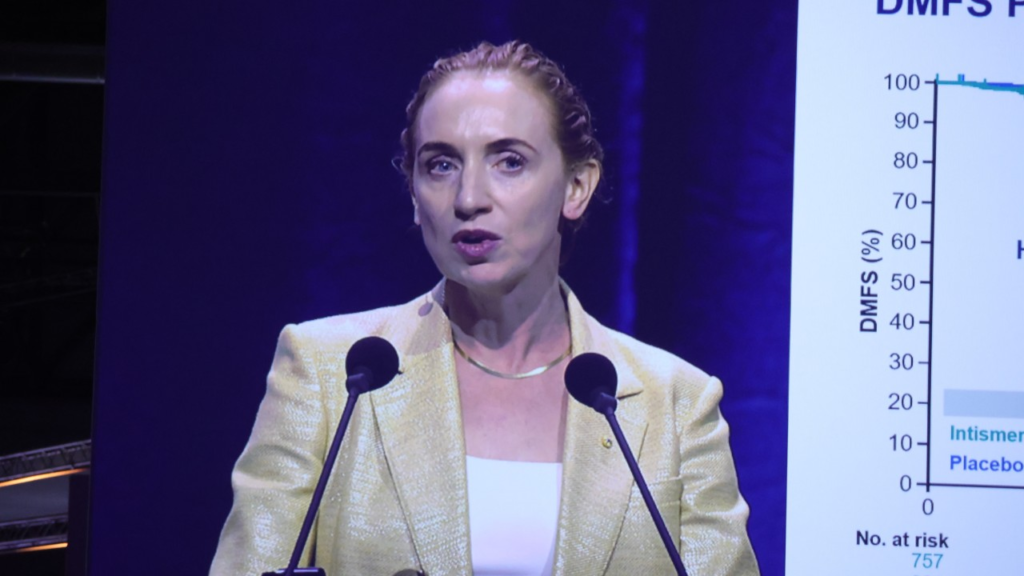
During a recent clinical oncology symposium, Professor Matthew D. Galsky from the Icahn School of Medicine at Mount Sinai presented the primary results of the Phase 3 KEYNOTE-B15 study (also known as EV-304). This trial evaluated the efficacy and safety of perioperative enfortumab vedotin (EV) in combination with pembrolizumab for patients with cisplatin-eligible muscle-invasive bladder cancer (MIBC).
A Breakthrough in Luminal-Targeted Therapy: First-in-Class PPARG Inhibitor FX-909 Demonstrates Potent Antitumor Activity and Precision Subtyping Potential

A Breakthrough in Luminal-Targeted Therapy: First-in-Class PPARG Inhibitor FX-909 Demonstrates Potent Antitumor Activity and Precision Subtyping Potential

At a recent major international oncology conference, Dr. Matthew D. Galsky from Mount Sinai presented updated data from a Phase 1 clinical trial (Late-Breaking Abstract, LBA639) and associated biomarker analysis of FX-909, a first-in-class peroxisome proliferator-activated receptor gamma (PPARG) inhibitor, in patients with advanced urothelial carcinoma (UC). The study data were simultaneously published in the top-tier journal Nature Medicine.
HCRN GU 20-444 Trial: Phase II Clinical Results of Pembrolizumab Monotherapy with a Response-Guided Bladder-Sparing Strategy in MIBC

HCRN GU 20-444 Trial: Phase II Clinical Results of Pembrolizumab Monotherapy with a Response-Guided Bladder-Sparing Strategy in MIBC

While radical cystectomy (RC) remains the standard of care for muscle-invasive bladder cancer (MIBC), it is associated with significant morbidity and long-term quality-of-life impacts. For elderly patients and those ineligible for cisplatin-based chemotherapy, effective bladder-sparing strategies are urgently needed in clinical practice. At a recent major international oncology conference, Dr. Jonathan F. Anker from Mount Sinai presented the latest data from the HCRN GU 20-444 study (Abstract 737). This Phase II clinical trial innovatively explored a pembrolizumab-based, response-guided bladder-sparing strategy in cisplatin-ineligible MIBC patients and conducted an in-depth analysis of the immense potential of circulating tumor DNA (ctDNA) in precisely identifying the population that stands to benefit. Oncology Frontier has summarized the core academic content below.
Toward Molecular Remission: IMvigor011 Exploratory Analysis Confirms ctDNA Concentration and Dynamics as Precise Prognostic Indicators in MIBC

Toward Molecular Remission: IMvigor011 Exploratory Analysis Confirms ctDNA Concentration and Dynamics as Precise Prognostic Indicators in MIBC

At a recent academic conference, Professor Joaquim Bellmunt from the Dana-Farber Cancer Institute, Harvard Medical School, presented the latest exploratory analysis results from the IMvigor011 trial. He provided an in-depth interpretation of the prognostic and predictive value of circulating tumor DNA (ctDNA) dynamics during adjuvant atezolizumab treatment for muscle-invasive bladder cancer (MIBC) following surgery.
43.2% Clinical Benefit Rate: Cabozantinib Demonstrates Potential in Heavily Pretreated R/R GCT

43.2% Clinical Benefit Rate: Cabozantinib Demonstrates Potential in Heavily Pretreated R/R GCT

During a recent oncology symposium, Dr. Jennifer King from Indiana University presented the results of a Phase II clinical trial (Abstract 587) evaluating cabozantinib in patients with relapsed/refractory germ-cell tumors (R/R GCT). This study explores the efficacy and safety of a multi-target tyrosine kinase inhibitor (TKI) in a patient population that has failed multiple lines of standard therapy.
Targeting HIF-2α and CDK4/6: A Novel Combination Strategy for Pretreated

Targeting HIF-2α and CDK4/6: A Novel Combination Strategy for Pretreated

In a recent academic session, Professor David F. McDermott from Beth Israel Deaconess Medical Center presented the latest findings from Part 1 of the LITESPARK-024 study. This trial evaluated the safety and preliminary efficacy of the HIF-2α inhibitor belzutifan in combination with the CDK4/6 inhibitor palbociclib in patients with previously treated advanced clear cell renal cell carcinoma (ccRCC).
Launch of the K-COMPAsS Model: A New Era of Precise Prognostic Assessment for Oligometastatic Clear Cell Renal Cell Carcinoma

Launch of the K-COMPAsS Model: A New Era of Precise Prognostic Assessment for Oligometastatic Clear Cell Renal Cell Carcinoma

At a recent international academic conference, Professor Chad Tang from The University of Texas MD Anderson Cancer Center presented pioneering research on circulating Kidney Injury Molecule-1 (KIM-1) and circulating tumor DNA (ctDNA) as prognostic markers for oligometastatic clear cell renal cell carcinoma (ccRCC). During the session, he officially introduced the K-COMPAsS model.
Toward Precise Monitoring: CLIMATE Study Confirms miR-371 Predicts Relapse in CS1 Testicular Germ Cell Tumors Better than Traditional Markers

Toward Precise Monitoring: CLIMATE Study Confirms miR-371 Predicts Relapse in CS1 Testicular Germ Cell Tumors Better than Traditional Markers

At a recent academic conference, Professor Ben Tran from the Peter MacCallum Cancer Centre and the University of Melbourne presented the preliminary results of the CLIMATE study (ANZUP 1906). This prospective cohort study aimed to evaluate the clinical utility of microRNA-371a-3p (miR-371) as a marker for minimal residual disease (MRD) in predicting relapse in patients with clinical stage 1 (CS1) testicular germ cell tumors (TGCTs).
Setback in First-Line Advanced Urothelial Carcinoma Exploration: Adding Anti-LAG-3/TIGIT to EV + Pembrolizumab Yields No Additional Benefit

Setback in First-Line Advanced Urothelial Carcinoma Exploration: Adding Anti-LAG-3/TIGIT to EV + Pembrolizumab Yields No Additional Benefit

At a recent international oncology academic conference, Professor Avivit Peer presented the latest findings from the KEYMAKER-U04 Substudy 04B. This study investigated the efficacy and safety of adding an anti-LAG-3 or anti-TIGIT antibody to the standard-of-care enfortumab vedotin (EV) plus pembrolizumab backbone as a first-line treatment for advanced urothelial carcinoma (UC). Our editorial team has summarized the core academic content for our readers.
Cytoreductive SBRT Plus Nivo/Ipi for mRCC: CYTOSHRiNk Phase II Trial Reveals Promising Safety and Response Durability

Cytoreductive SBRT Plus Nivo/Ipi for mRCC: CYTOSHRiNk Phase II Trial Reveals Promising Safety and Response Durability

At a recent international academic symposium, Dr. Aly-Khan A. Lalani from McMaster University presented the primary results of the CYTOSHRINK study (Abstract 416). This randomized Phase II trial evaluated the efficacy and safety of cytoreductive stereotactic body radiotherapy (SBRT) combined with nivolumab plus ipilimumab (Nivo+Ipi) in patients with treatment-naïve metastatic clear cell renal cell carcinoma (mRCC).